


Plants in the genus Castilleja have long been one my wife’s favorite wildflowers. Not simply because they are lovely bursts of color exciting the landscape, but because of the name. Whenever we see one, we musically intone Cast-ti-LAAY-HAAA, and then giggle because, well, because we think we are being darned cute. Plus, how often does one have the chance to say such a melodic name, one derived from the 18th century Spanish botanist Domingo Castillejo? For us, it’s every time we see one, so perhaps we shouldn’t chuckle as often as we do.
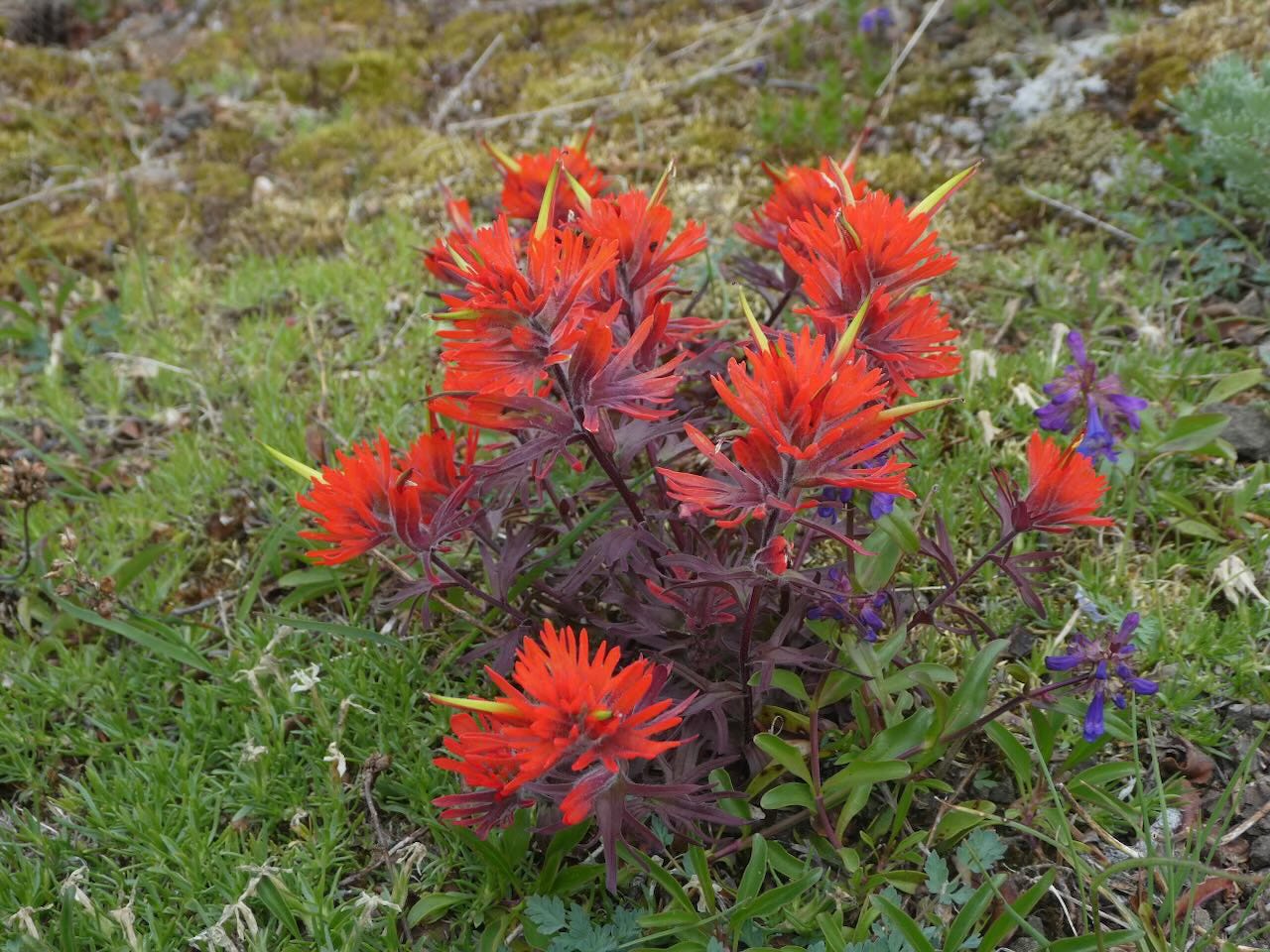
If you are not familiar with Castilleja, you might recognize the common name, which is applied to almost every species within the genus: paintbrush. (They were long known as Indian paintbrush, but fortunately most have dropped the first part of the designation.) Paintbrushes favor the long wavelength of the Roy (of Roy G. Biv fame) part of the rainbow, dazzling in reds, oranges, and yellows, though some also can be white or magenta. When you see one, you can clearly see why the plants merit their common name.
That vivacious color though does not come from the flowers, which are inconspicuous and green. Instead, modified leaves, known as bracts, bestow the color of the paintbrush clan. An adaption such as this is good for the plants because the bracts provide benefits including display of warning signals, camouflage of conspicuous reproductive organs, and amelioration of external threats, such as rain, low temperature, and UV radiation. Colorful bracts are also a long distance attractant, which appears equally successful whether human or pollinator. In this capacity, bracts function like a narcissist: “Ooh, ooh look at me. Ain’t I pretty.” Other classic examples of bracts masquerading as flowers include poinsettias, dogwoods, and bougainvilleas.
Found from sea to summit, Castilleja is a rich genus of around 180, notoriously-hard-to-distinguish species. In 1862, the great botanist Asa Gray wrote that “the species of this genus are most troublesome and unsatisfactory,” a statement still subscribed to by many botanists and plant lovers. The problem is that Castilleja are promiscuous to the point that if they were humans, we’d question their morals, but they are plants, so we merely question their status. The result of all this commingling are hybrids that don’t hue to the hue of their parents. Nor can one rely on morphology or genetics, which taxes even the most determined taxonomists. (Okay, enough of the silly world play.) In other words, they be troublesome.
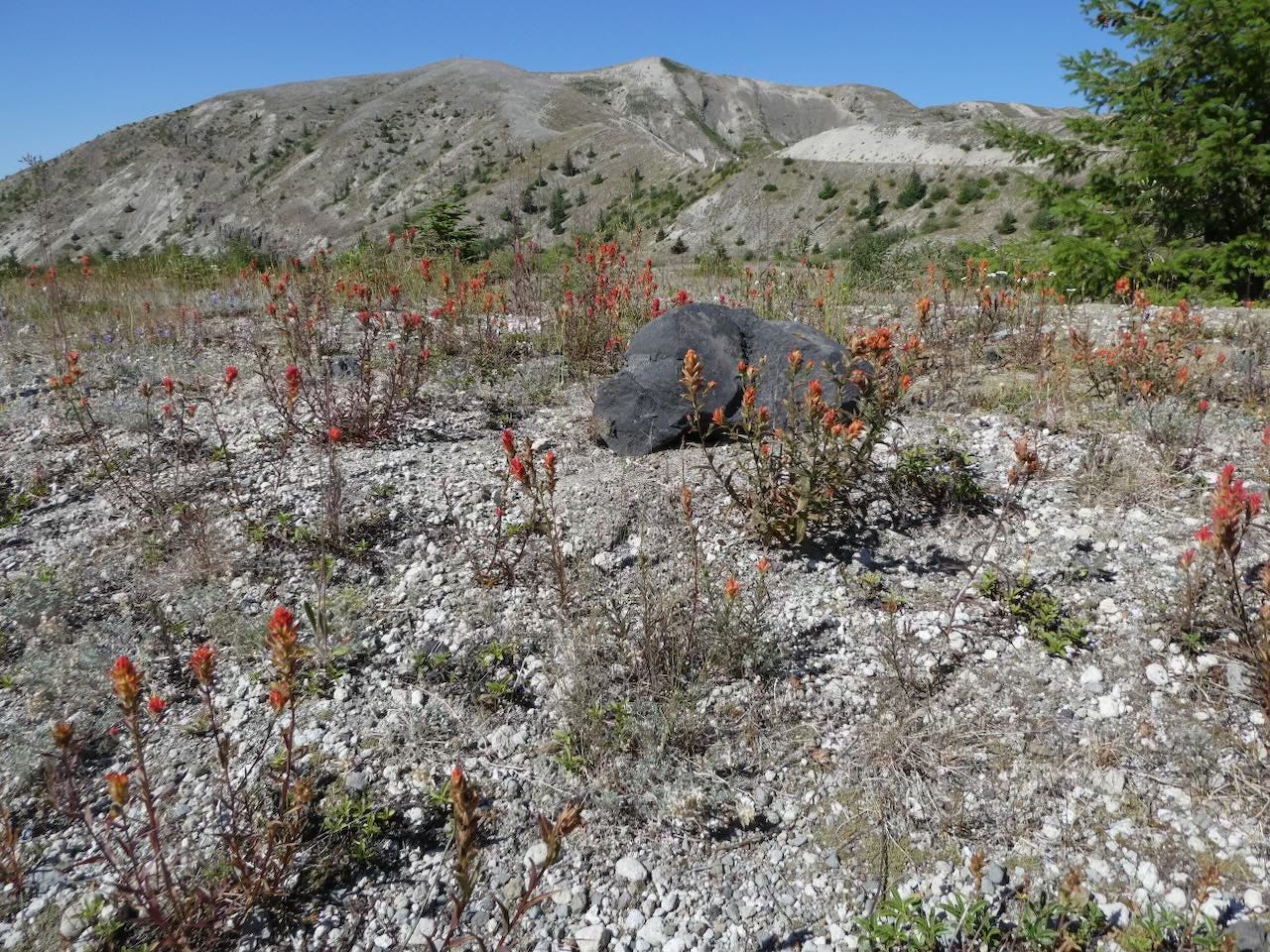
I don’t even try to distinguish which species I am seeing. Our most common are C. parviflora, which tend to be reddish to magenta, often in the sub-alpine and alpine; C. miniata, generally scarlet, at all elevations; and C. hispida, scarlet or yellow bracts, at low to middle elevations. Because of their loose mating habits, I have found that it’s simpler and much more satisfying to only say Cast-ti-LAAY-HAAA.
Not just deceivers with their colorful bracts, paintbrushes play another trick; they are vampire-like, sucking nutrients and water from other plants. In order to extract their host’s vitality, paintbrush send out finger-like parasitic tissues, known as haustoria, and form a root to root, one-way subway of sucking of key elements such as carbon and nitrogen. Paintbrushes though do not depend entirely upon their hosts; with their green leaves they can also photosynthesize but went an additional step and evolved the ability to supplement their own resources by taking them from another. Ecologists refer to organisms such as Castilleja as hemiparasites or facultative parasites.
Despite their manner of drinking up a host’s essential life forces, hemiparasites such as Castilleja are not all bad. Yes, they reduce their host’s productive, reproductive, and competitive abilities, all of which can be considered negative, but hemiparasites also have positive effects. Studies have found that they enhance nutrient cycling, particularly in nutrient-poor ecosystems. Intriguingly, they do via leaf litter, basically taking nutrients from one host and converting them to a more usable form and releasing them back into the ecosystem when they drop their leaves. Hemiparasites appear to further enhance their surrounding plant communities by interacting with and affecting soil microbes.
Long looked down upon as detrimental suckers of life, Castilleja instead are now being thought of as ecosystem engineers, or organisms such as pikas, that modulate the availability of resources. In other words, they help a community be a community by performing a role that is neither good nor bad. Castilleja are simply one of the uncountable, interconnected strands of the web of life, which evolution has woven together to comprise the beautiful and complex ecosystems that make up our world. Long live diversity in its many wonderful forms.
Excited that an excerpt from my book appeared in the Seattle Times on Sunday! It’s from my chapter on peopling the Cascades, which explores the 10,000 year plus history of people in these mountains.
Honored to be part of this splendid KCTS story about Puget Sound as a maritime highway. Click on Waymakers on the Water.


