


The kid started screaming the other night. We first heard the cries on a walk near our house. They were high pitched and short, lasting just a second at most, followed by a pause, and a repeat. Then a break, or not. Sometimes the kid called several times in succession. Other times, a single call or two, then 5 to 10 minutes of silence. Although we looked, we couldn’t trace the origin of the sound.
Back at home, we continued to hear the kid. It turned dark, we got in bed, and still the calls pierced the air. Finally, I got up and tried to figure out who was making such a racket, disturbing my sought after slumber. Taking my phone, I walked out the back door in my pajamas and held it up. No calls. Now, the kid turns quiet! But eventually the sounds returned. A Red-tailed Hawk was calling and kept calling for quite awhile. I couldn’t complain; such a unique way to be serenaded to sleep in a city of 750,000 people. Like me, the kid was also an early riser, starting to call at 5:00 AM; as they say, there’s a reason babies are so cute.
As soon as the Merlin app informed me of the origin of the sound, I realized that the hawk was the only bird that could be making that call in our neighborhood. No other bird produces such a succinctly pitched note. My reason for not figuring it out sooner is that the caller was indeed a kid, a young Red-tailed Hawk who had probably recently fledged. In contrast to the short call of the kid, adults produce their longer, screaming kee-eeeee-arr, which shrills for two to three seconds. It’s an unmistakable sound and the classic bird call of gazillions of movies.
As I have noted in previous newsletters, Red-tailed Hawks are a very common urban bird. I regularly see them when I cross over the freeway near our house heading to the Light Rail station at Northgate. I have long suspected that a pair nests around here, but have not found the nest, so it was exciting to hear the kid calling. Calling though may not be the best word to describe the sound; it seemed more of a cry for attention. Mom, don’t forget me!
Once a young redtail has fledged and started to discover his or her world, the bird still relies on their parent for food. Not surprisingly, young birds are not good hunters or even very aware of how to hunt, as exemplified by the young Northern Harriers my pal Andy saw in Sequim. Here in an urban environment young birds such as redtails face numerous perils, particularly if they try hunting along an interstate freeway dominated by speeding walls of death.
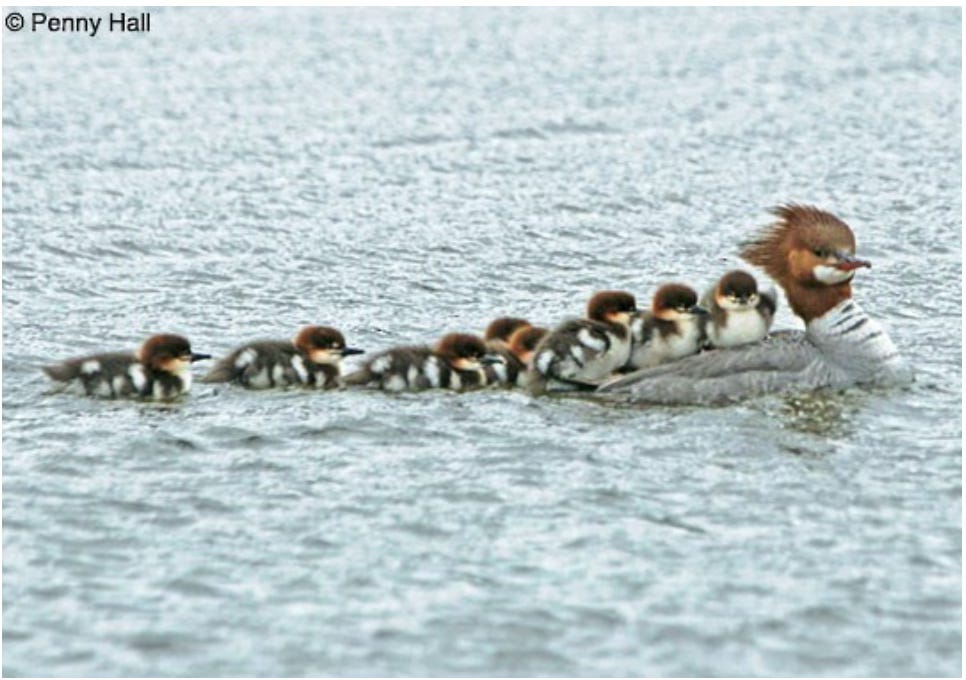
The young Red-tailed Hawk is not the first youngster I have seen in Seattle. Goslings and ducklings abound at Green Lake. Black-capped Chickadees regularly nest in two nest boxes in our yard, and I have heard their cries for attention many times. My recent highlight was seeing female Common Merganser at Lake Washington carrying several babies on her back. Although I haven’t seen young robins, I have come across the baby blue eggs; no clue if they are where they are because of a nearby unseen nest or the result of someone such as a crow finding a tasty tidbit.
Writing of crows, their young take my prize for the most whiny baby bird. One has been a regular visitor to our yard over the past several weeks. I cannot remember the first time I heard the call, but soon after the bird was out of the nest and calling, our neighbor saw the youngster on the ground. She told me that the bird didn’t look well so she picked the kid up, attempted to feed her some water, and placed the bird in a “safe” bush. (Everything the neighbor did was wrong; forcing water into a young crow, or even using a syringe or dropper, can kill young crows, or most any other baby bird, and the parents were probably near by and well aware of where their kid was.) Fortunately, the young bird survived our neighbor’s good but incorrect intentions.
As the kid got older, the cawing became more regular, meaning anytime of day from dawn through dusk. I heard the calls at our bird bath, from trees throughout the yard, on our roof, across the street on telephone wires, on the ground, on the wing, and even when a parent was right next to the kid. For the most part, the calls’ persistence and tone came across as exceptionally needy pleas for attention. Mom, Mom, MOM, MOM!!
Of course, the calls are more diverse and nuanced than how my non-corvid ears can perceive. Those humans who know more about crows describe them as great communicators, who have a “complex language, steeped in cultural tradition,” write John Marzluff and Tony Angell in their book In the Company of Crows and Ravens. More than likely the kid was sharing a variety of information with mom, which would help both of them survive. As was the redtail youth; perhaps not as complex and nuanced as the crows but certainly as central to their family.
No matter what the crow baby and the redtail baby were saying to their respective parents, I enjoy sounds such as these, even if they come late at night or early in the morning. (Certainly, they are vastly better than my neighbor’s perpetual use of a leaf blower, which is annoying me as I type.) I am always thrilled to see and hear animals living out their lives in our urban ecosystem. To see the next generation figuring out how to continue that cycle of life further brings hope and inspiration, feelings that are so necessary in the challenging world we all inhabit.
NB - One interesting note to add. In the video above, the young Red-tailed Hawk sits prominently on a limb, very obvious to every human and bird around. Oddly, at least to my eyes, no crows are dive bombing the kid. If this was an adult, I am sure, and I have seen this in the trees around our house many times, the crows would have been apoplectic, determinedly harassing the larger bird. I wouldn’t be surprised if the crows recognize this youngster as not being a threat. Perhaps that somewhat whiny call also sends a message to other birds, which they can interpret as they please.


