


Recently, I experienced a natural history phenomenon I haven’t in many years: Marjorie and I had to stop to wash the bugs off our windshield. We were in the Sonoran Desert driving east from Tucson, Arizona, on Interstate 10. About fifteen miles west of Wilcox, I heard a light thunk on the windshield, simultaneous with the appearance of the classic bug splat. Within another ten minutes, bodies peppered the glass, so many that we needed to pull over at the next gas station and clean them off.
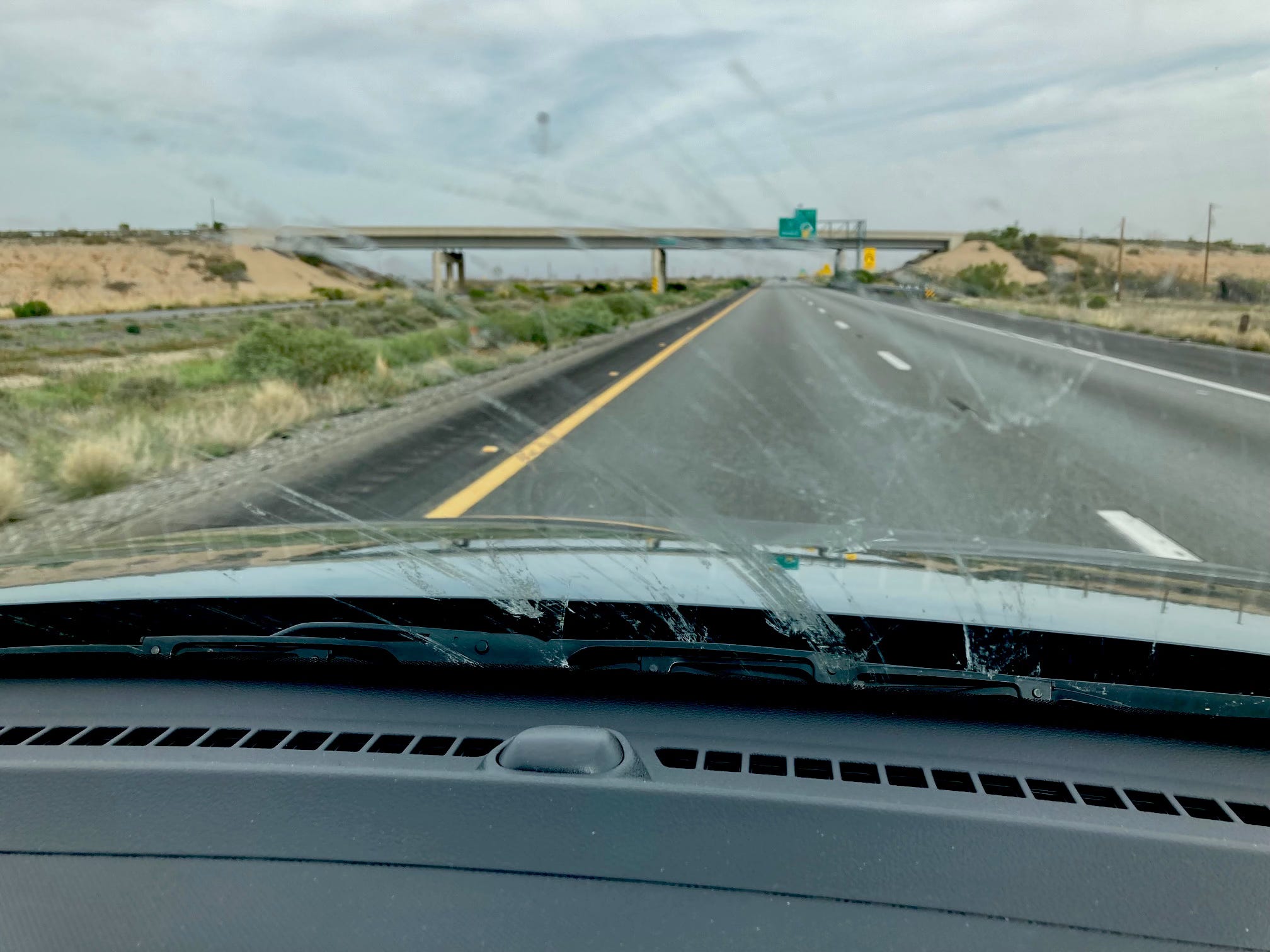
About thirty minutes later, we got splatted again. This time it was a swarm. I initially thought it was hailing, the thwacks were so many and so loud, but I quickly realized we were passing through a cloud of bugs, quite a few of which concluded their brief life by colliding with our car and ink blotting the glass with yellowish and whitish viscera. It reminded me of an old joke from my youth. What’s the last thing to go through a bug’s mind when he hits your windshield? His toucas. (What else would you expect from me?)
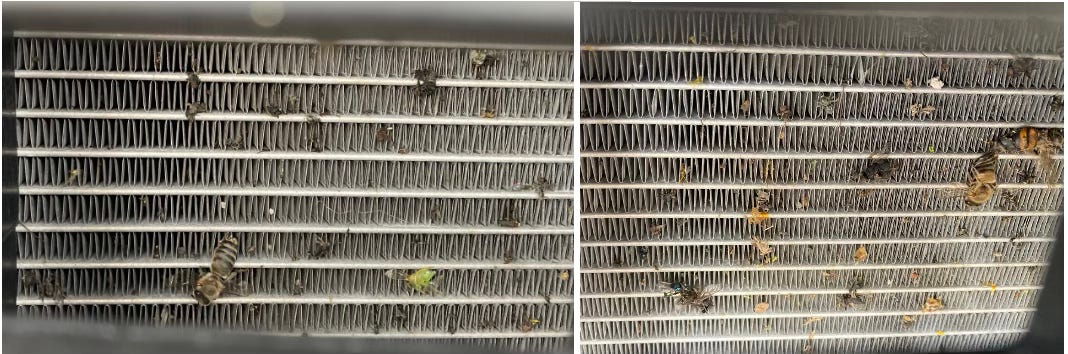
We immediately turned the windshield wipers on to maximum and blasted the cleaning fluid, but to little avail; our efforts were futile against the sticky sea of bug guts. Once again, we had to find the nearest gas station, which was another 10 to 15 minutes down the road. Before cleaning, I tried to figure out who we had hit, but not enough body parts remained on the glass to do so. Being the ecodork I am, I realized that I could peer through the front grill and see a host of insects: it looked to be several species of bees, a butterfly, a green stink bug (?), and a couple of species of flies.
I have encountered an abundance of insects such as this only a few times. Two stand out. The first was on a bike ride in eastern Colorado, the one I mentioned in Ode to My Bike. I was riding with two friends when we were met by a Biblical multitude of Mormon crickets (Anabrus simplex). Gazillions covered the road for miles; their flattened, slick orangish bodies made riding dangerous, and we wondered if car drivers would need studded tires to stay safe. (Mormon crickets aren’t true crickets. They look like grasshoppers but cannot fly; they are also cannibalistic, so our ride was a macabre combination of death and feasting. Their name derives from the seething hordes that devastated the crops of Mormon settlers; they were saved by cricket-hungry California gulls.) Although I didn’t enjoy biking through the slick of dead bugs, I remember being amazed at the shear number of insects; it was bounty of life (and death) that gave me a new appreciation for insect adaptation.
I also once had the pleasure of seeing a massive migration of painted lady (Vanessa cardui) butterflies. Orange, black, and white but smaller and less well-known than monarch butterflies, painted ladies annually migrate north and south parallel to and on either side of the Sierra Nevada Range. Normally, most people don’t notice this amazing, multi-generation migration but an alignment of weather and flowers occasionally triggers a superswarm, which can total in the billions. I was lucky to see one when visiting a friend at Sequoia-Kings Canyon National Park. Everywhere we looked we saw the two- to three-inch wingspan butterflies, streaming across roads and meadows; it felt as if the wind had taken a corporeal form of winged beauty.
As I noted, such encounters are rare. In fact, it has seemed to me over the past decade or two that I seldom have the need to clean bugs off my windshield, particularly as compared to driving in my younger days. I am not alone. Many people have a similar perception, a perception often dubbed the windshield phenomenon, a term that developed in part from a 2019 research paper. Ecologist Anders Pape Møller used 1,375 surveys of insects killed over twenty years on car windshields as a measure of insect abundance. He concluded that a direct connection existed—fewer bugs thus fewer windshield bug carcasses—which is why people like me saw fewer dead bugs on our cars.
The problem is that Møller’s study is flawed; much of his work is based on assumptions that aren’t realistic. He’s not wrong though that there is a worldwide crisis in insect biodiversity. Scientific studies from the tropics to forests to urban environments show a disconcerting drop in the absolute number of insects, along with a corresponding change in insect community structure. The reasons include the usual array of human caused factors including habitat loss, climate change, and increased pesticide use. Because insects are so important in so many ecosystems, the biodiversity loss is resulting in negative impacts on ecological functions, food production, and human health.
I was disappointed when I learned of the issues with Møller’s work and the windshield phenomenon. I had heard of the study since it first appeared and thought that I, too, was proving science right. Not surprisingly, anecdotal evidence is not scientifically valid, and the insect biodiversity story is far more complicated. Fortunately—or unfortunately because the numbers are dire on so many levels—good and accurate science is being done by scientists across the globe, which clearly shows the many ecological challenges that we face.
I admit that I am happy not to be debugging my windshield as often as I used to, but I sort of enjoyed doing it again the other day. (I am sorry that our driving killed so many insects.) It was great to experience an abundance of wild things and to know such Biblical swarms were still possible, even in the face of the catastrophic drop in insect biodiversity. Such is what passed through my mind after driving through a bug swarm in southern Arizona.
– March 24, 2026 – Book Launch – MOHAI – I am excited to share the stage with my pal Jennifer Ott for the book launch of the new edition of our book Seattle’s Locks and Ship Canal: A History and Guide. Here’s how to register.
– March 26, 2026 – Wild in Seattle/Seattle Walks – 7pm – Redmond Senior and Community Center – Eastside Audubon Society – I’ll be talking about my book Wild in Seattle. Here’s some info.


